

LIFEPAK CR2 AED with WiFi Connectivity
PART NUMBER: AED-901SAWProduct Specifications
| 9.7cmx22.6cmx27.4cm | |
| Yes | |
| Each | |
| AED-901SAW |
Get a Quote
Added. View Quote.
Product Description
Stryker LIFEPAK CR2 Wi-Fi AED

Advanced. Connected. Rescue Ready.
The Stryker LIFEPAK CR2 is not simply another automated external defibrillator. It is a modern, connected AED platform designed to help make the entire response to sudden cardiac arrest faster, simpler and more effective.
Built on the LIFEPAK legacy used throughout emergency medicine, the LIFEPAK CR2 brings advanced defibrillation technology into workplaces, schools, industrial facilities, public buildings, recreation facilities, remote sites and other public-access environments.
What makes the CR2 different is the combination of technologies inside one device: cprINSIGHT™ analysis during chest compressions, escalating defibrillation energy up to 360 joules, adult and pediatric treatment using the same electrode set, Wi-Fi connectivity, automated self-monitoring and integration with Stryker’s LIFELINKcentral™ AED Program Manager.
The result is an AED designed not only to be easy to use during an emergency, but also easier to keep ready before an emergency ever happens.
Why Pickering Safety Recommends the LIFEPAK CR2
When an organization purchases an AED, it is easy to compare devices based only on purchase price.
We believe there is a more important question:
What AED would you want available if someone actually went into cardiac arrest?
That changes the conversation.
An AED may spend years mounted on a wall before it is required. When that day comes, it must be operational, its battery must have sufficient capacity, its electrodes must be usable, the rescuer must be able to understand it, and the device must deliver appropriate therapy with as little interruption to CPR as possible.
That is where the LIFEPAK CR2 stands apart.
What Makes the LIFEPAK CR2 Different From Other AEDs?
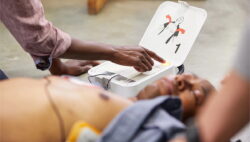
There are many AEDs available today, and they all have the same fundamental purpose: recognize a shockable cardiac rhythm and deliver defibrillation therapy.
However, there can be significant differences in how an AED analyzes the patient, how pediatric patients are treated, how long consumables last, how the device is monitored, what energy levels are available, and how easily an untrained rescuer can operate it.
These differences matter.
The LIFEPAK CR2 combines a number of advanced capabilities into one platform that are not necessarily available together on conventional public-access AEDs.
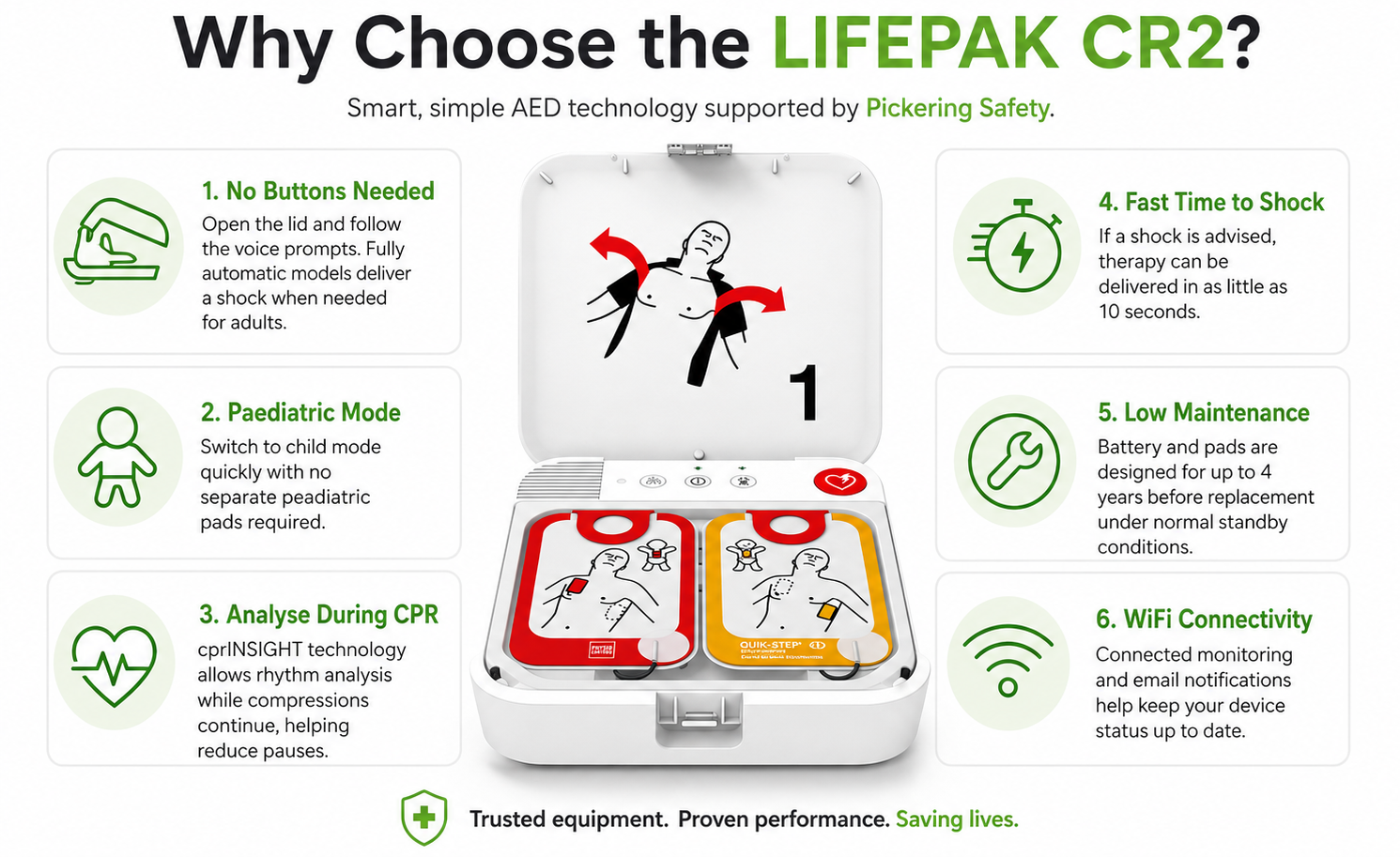
1. Rhythm Analysis While CPR Continues
Many AEDs require rescuers to completely stop chest compressions while the device analyzes the patient’s heart rhythm.
The LIFEPAK CR2 with cprINSIGHT™ is designed to analyze the patient’s ECG while chest compressions continue.
This is a major difference.
Interruptions in chest compressions interrupt circulation.
By performing rhythm analysis during CPR, the CR2 is designed to reduce unnecessary pauses in chest compressions and help maintain continuity of CPR throughout the rescue.
2. Escalating Energy Up to 360 Joules
Maximum energy capability varies considerably between AED platforms.
Some public-access AEDs provide adult defibrillation therapy in the approximate 150 to 200 joule range.
The LIFEPAK CR2 is capable of escalating adult therapy through:
200 J → 300 J → 360 J
This gives the CR2 additional therapeutic capability when repeated shocks are required.
Higher available energy does not mean every patient automatically receives 360 joules. Therapy follows the programmed protocol.
It means the CR2 has the ability to escalate therapy when appropriate.
3. One Electrode Set for Adults and Children
Pediatric preparedness is one of the biggest differences between AED systems.
Some AEDs require:
- Separate pediatric electrodes
- A separate pediatric cartridge
- An additional pediatric accessory
- Changing electrodes before treating a child
That creates more equipment to purchase, track, inspect and replace.
The LIFEPAK CR2 uses the same QUIK-STEP™ electrodes for adults and children.
Simply press the CHILD MODE button.
The CR2 automatically adjusts the energy level and CPR guidance appropriately.
One AED.
One set of electrodes.
Adult or child rescue.
For schools, recreation centres, hotels, municipalities and other public-access environments, this is an important operational advantage.
4. Four-Year Electrode Life
Electrode replacement cycles differ substantially between AEDs.
Some commonly used AED electrodes require replacement approximately every two years.
The LIFEPAK CR2 QUIK-STEP electrodes have an approximately four-year shelf life.
That can mean:
- Fewer replacement cycles
- Fewer purchase orders
- Less inventory management
- Fewer expiry dates to track
- Less administrative work
- Reduced likelihood of discovering expired pads
- Simplified management across multiple AED locations
Over the operational life of an AED, consumable replacement frequency can make a significant difference.
5. Four-Year Battery Life
Battery replacement schedules also vary between AED platforms.
The LIFEPAK CR2 uses a long-life lithium manganese dioxide battery with approximately four years of standby life when installed and maintained according to manufacturer requirements.
This closely aligns the battery replacement cycle with the electrode replacement cycle.
For an organization managing multiple AEDs, aligning the major consumables around a four-year cycle can make program administration considerably simpler.
6. Connected AED Monitoring
Many traditional AEDs function independently.
They sit inside a cabinet and depend largely on someone physically checking them to make sure they are ready.
The Wi-Fi LIFEPAK CR2 provides another level of oversight.
When connected to Stryker’s LIFELINKcentral™ AED Program Manager, device readiness information can be communicated remotely.
This gives organizations an opportunity to identify issues requiring attention without relying exclusively on physical inspections.
For organizations operating multiple facilities, this can fundamentally change how an AED program is managed.
7. Automatic Readiness Monitoring
AEDs generally perform self-tests, but there is an important difference between a device performing a self-test and an organization being alerted that attention may be required.
The LIFEPAK CR2 combines automatic self-testing with connected readiness capabilities.
The CR2 can identify conditions involving:
- Battery status
- Electrode status
- Expired electrodes
- Used electrodes
- Device readiness
- Service requirements
This provides another layer of protection against an AED quietly sitting in a cabinet while requiring attention.
8. No Screen Required to Navigate the Rescue
Some modern AEDs use colour screens, touchscreen interfaces or video demonstrations.
Those can be useful features.
The LIFEPAK CR2 takes a different approach.
Its design emphasizes:
- Immediate activation
- Clear voice instructions
- Large visual graphics
- Simple controls
- Pre-connected electrodes
- Minimal steps
- CPR coaching
During cardiac arrest, simplicity is critical.
The person using the AED may have never touched one before.
They may be frightened, under extreme stress and surrounded by distractions.
The CR2 is designed around helping that person move through the rescue quickly.
9. Pre-Connected Electrodes
Some equipment configurations require additional steps before treatment can begin.
The CR2’s QUIK-STEP electrodes are already connected to the device.
The responder opens the AED, removes the electrodes and applies them according to the illustrations and voice instructions.
Fewer steps can mean less confusion during an emergency.
10. Bilingual Capability
Not every AED platform offers the same language capabilities.
Configured LIFEPAK CR2 models can provide bilingual operation, allowing the responder to switch between two preset languages.
For Canadian organizations, this can be particularly valuable.
11. Up to IP55 Environmental Protection
AEDs are not always installed in climate-controlled offices.
They may be placed in:
- Industrial facilities
- Warehouses
- Public works facilities
- Construction operations
- Transportation environments
- Marine operations
- Remote worksites
- Recreation facilities
The LIFEPAK CR2 carries an IP55 rating, providing protection against dust and water intrusion under specified test conditions.
Appropriate storage and environmental controls are still required, but the CR2 was designed with real-world deployment in mind.
cprINSIGHT™: Analyze the Heart Rhythm While CPR Continues
One of the most important technologies built into the LIFEPAK CR2 is Stryker’s proprietary cprINSIGHT™ analysis technology.
Traditional AED operation commonly requires the rescuer to stop chest compressions while the AED analyzes the patient’s ECG.
Every interruption means chest compressions are temporarily no longer circulating blood.
The LIFEPAK CR2 is designed to analyze the patient’s heart rhythm while CPR is being performed.
Once CPR is underway, cprINSIGHT can determine whether a shockable rhythm is present while chest compressions continue.
This is designed to reduce interruptions in CPR.
Why does that matter?
Because during cardiac arrest, the objective is not simply to attach an AED.
The objective is to maintain effective CPR while getting appropriate defibrillation therapy to the patient as quickly as possible.
The CR2 is designed around that complete resuscitation process.
Escalating Energy Up to 360 Joules
Not every cardiac arrest responds to the first shock.
The LIFEPAK CR2 is capable of escalating adult defibrillation energy through configurable levels up to 360 joules.
Its default adult energy sequence is:
200 J → 300 J → 360 J
Pediatric default energy levels are:
50 J → 75 J → 90 J
Some public-access AED platforms have lower maximum adult energy capabilities.
The CR2 provides escalating energy capability up to 360 J when required by the programmed rescue protocol.
This gives organizations a public-access AED with significant therapeutic capability.
One Set of Electrodes for Adults and Children
Cardiac arrest does not only affect adults.
One of the practical challenges with some AED systems is pediatric preparedness.
Depending on the device, organizations may need to purchase and maintain:
- Adult electrodes
- Pediatric electrodes
- Pediatric cartridges
- Pediatric keys or accessories
Each additional component creates another potential expiry date, another item to inspect and another component that must be available when an emergency occurs.
The LIFEPAK CR2 simplifies this dramatically.
The CR2 uses the same QUIK-STEP electrodes for adult and pediatric patients.
For a pediatric patient, the rescuer simply presses the clearly identified:
CHILD MODE
The AED then reduces the defibrillation energy and adjusts its CPR guidance.
There is no need to search through an AED cabinet for another package of electrodes.
For schools, recreation facilities, community centres, hotels, municipalities, First Nations communities, workplaces and other public-access locations, this can significantly simplify AED preparedness.
Four-Year QUIK-STEP™ Electrode Life
The LIFEPAK CR2 QUIK-STEP electrodes have an approximately four-year shelf life.
They are pre-connected to the AED and stored inside the device so they can be rapidly accessed during an emergency.
Many AED owners underestimate the long-term importance of electrode replacement.
AED electrodes are consumable medical products.
They expire whether the AED is used or not.
A longer electrode replacement cycle can mean:
- Fewer replacement purchases
- Fewer expiry dates
- Less administration
- Less maintenance
- Less inventory
- Easier budgeting
- Greater consistency across a fleet
For an organization with 25, 50 or 100 AEDs, those operational differences become substantial.
Four-Year Battery
The LIFEPAK CR2 uses a lithium manganese dioxide battery with approximately four years of installed standby life under specified conditions.
A new battery can provide approximately:
- 800 minutes of operating time, or
- 166 discharges at 200 joules
under published test conditions.
The approximate four-year battery and four-year electrode replacement cycles can simplify long-term AED program management.
Connected AED Readiness with Wi-Fi
Buying an AED is only the first step.
The real responsibility is ensuring the AED remains rescue ready.
A Wi-Fi-connected LIFEPAK CR2 can communicate with Stryker’s LIFELINKcentral™ AED Program Manager.
Depending on configuration, organizations can remotely receive device-readiness information and notifications when attention may be required.
This can be particularly valuable for organizations operating:
- Multiple offices
- Multiple schools
- Multiple worksites
- Multiple branches
- Multiple recreation facilities
- Geographically dispersed operations
One AED is easy to check.
Fifty AEDs are an asset-management program.
Connected technology becomes increasingly valuable as the fleet grows.
The AED Can Tell You When It Needs Attention
The LIFEPAK CR2 performs automatic self-tests.
The device provides a visual readiness indicator and can generate audible alerts when attention is required.
Connected configurations add another layer of monitoring by communicating device information through the management platform.
Potential conditions requiring attention can include:
- Battery condition
- Electrode status
- Electrode expiry
- Used electrodes
- Device readiness
- Service requirements
This matters because simply owning an AED does not guarantee that it is rescue ready.
An AED program must be managed.
Designed for the Person Who Has Never Used an AED Before
During an actual cardiac arrest, the person reaching for the AED may not be a healthcare professional.
They might be:
- A teacher
- Office worker
- Construction worker
- Security officer
- Coach
- Parent
- Hotel employee
- Retail employee
- Bystander
The design therefore has to work under stress.
Opening the CR2 begins the rescue sequence.
Voice instructions and visual graphics guide the responder through the process.
The system is designed to reduce unnecessary steps and help the rescuer move quickly from opening the AED to CPR, electrode placement and defibrillation.
QUIK-STEP™ Electrodes
The LIFEPAK CR2’s QUIK-STEP electrodes are pre-connected and stored inside the AED.
The responder removes them from their storage system and follows the illustrated placement instructions.
There is no need to find an electrode cable and connect it before beginning treatment.
During cardiac arrest, every unnecessary step creates another opportunity for hesitation or confusion.
Bilingual English and French Operation
Configured bilingual LIFEPAK CR2 models allow rescuers to switch between two preset languages.
For Canadian organizations, bilingual rescue guidance can be particularly useful for:
- Municipalities
- Federal organizations
- National businesses
- Transportation facilities
- Schools
- Universities
- Public facilities
- Hotels
- Tourism operators
- Multi-province organizations
Designed for Demanding Environments
The LIFEPAK CR2 carries an IP55 rating for dust and water protection under specified testing conditions.
It has also undergone environmental testing relating to shock and vibration.
This makes the CR2 a strong candidate for many environments including:
- Construction
- Warehousing
- Manufacturing
- Mining
- Utilities
- Transportation
- Marine operations
- Remote sites
- Film and television production
- Recreation facilities
- Public works
- Schools
- Commercial buildings
Extremely wet, cold, hot or dusty applications should always be assessed individually to ensure appropriate AED placement and storage.
How Does the LIFEPAK CR2 Compare With Other Types of AEDs?
When comparing AEDs, look beyond the initial purchase price.
Ask these questions.
Does the AED use the same electrodes for adults and children?
With the CR2: Yes.
Is a separate pediatric pad package required?
With the CR2: No.
Is a separate pediatric cartridge required?
With the CR2: No.
Can pediatric mode be selected directly on the AED?
With the CR2: Yes. Press the CHILD MODE button.
Can the AED analyze the heart rhythm while CPR continues?
With cprINSIGHT-equipped CR2 models: Yes.
Can adult therapy escalate beyond 200 joules?
With the CR2: Yes. Up to 360 joules.
Are the electrodes pre-connected?
With the CR2: Yes.
Do the electrodes last approximately four years?
With the CR2: Yes.
Does the installed battery provide approximately four years of standby life?
With the CR2: Yes, under specified conditions.
Can the AED connect through Wi-Fi?
With the CR2 Wi-Fi model: Yes.
Can device readiness be monitored remotely?
With an appropriately connected and configured CR2: Yes.
Does it perform automatic self-tests?
Yes.
Does it provide a visible readiness indicator?
Yes.
Are bilingual configurations available?
Yes.
Can it form part of a centralized AED management platform?
Yes.
Can rescue-event data be recorded?
Yes.
Does it provide up to 360 J adult energy capability?
Yes.
That combination is what makes the LIFEPAK CR2 such a compelling choice.
Not All AEDs Are the Same
It is tempting to view AEDs as interchangeable.
They are not.
Two AEDs can both be approved for public-access defibrillation while having very different:
- Electrode replacement schedules
- Battery replacement schedules
- Pediatric systems
- Energy capabilities
- CPR analysis technology
- Connectivity
- Remote monitoring
- Environmental ratings
- User interfaces
- Rescue workflows
- Fleet-management capabilities
That is why Pickering Safety encourages customers to compare the complete ownership and rescue experience, not simply the initial AED price.
A lower purchase price can become less meaningful if the device requires more frequent consumable replacement, separate pediatric equipment or greater manual administration over its service life.
Compare Total Cost of Ownership
The initial AED purchase is only part of the cost.
Organizations should also consider:
- Replacement electrodes
- Pediatric electrodes or accessories
- Replacement batteries
- Shipping costs
- Staff time spent checking devices
- Consumable tracking
- Administration
- Multi-location inspections
- Post-use consumable replacement
- Program management
The LIFEPAK CR2’s four-year battery and electrode cycles, combined with its adult/pediatric electrode design and connected management capabilities, can simplify the ongoing ownership model considerably.
This becomes even more important as an organization’s AED fleet grows.
Connected Through the Chain of Survival
CR2 connectivity is not limited to maintenance.
The CR2 records rescue-event information that can support post-event review and continuity of care.
Depending on configuration and system connectivity, event information can include:
- ECG information
- Shock information
- Event timeline
- Device activity
- Rescue data
The CR2 therefore functions as more than an isolated box mounted to the wall.
It becomes part of a broader emergency-response system.
LIFEPAK Technology and the Professional Emergency-Care Connection
The LIFEPAK name has a long association with professional emergency cardiac care.
The CR2 brings that technology into public-access defibrillation while remaining part of Stryker’s broader emergency-care ecosystem.
For Pickering Safety, this is one of the reasons we strongly recommend the platform.
We do not believe an AED should be selected simply because it has the lowest purchase price.
The objective is to place reliable emergency medical technology where ordinary people can use it during an extraordinary event.
LIFEPAK CR2 Wi-Fi Key Features
- Stryker LIFEPAK CR2 AED
- cprINSIGHT™ analysis technology
- ECG analysis while chest compressions continue
- Escalating adult energy capability up to 360 J
- QUIK-STEP™ pre-connected electrodes
- Same electrodes used for adults and children
- Dedicated Child Mode button
- Approximately four-year electrode shelf life
- Approximately four-year installed battery standby life
- Wi-Fi connectivity
- LIFELINKcentral™ AED Program Manager compatibility
- Remote readiness information
- Automatic self-testing
- Readiness alerts
- CPR coaching
- CPR metronome
- Visual rescue instructions
- Audible rescue instructions
- Available bilingual configurations
- Automatic and semi-automatic configurations available
- IP55 dust and water protection
- Event data recording
- Integration with Stryker emergency-care systems
Technical Specifications
Manufacturer: Stryker / Physio-Control
Model: LIFEPAK CR2
Device Type: Automated External Defibrillator
Configuration: Semi-automatic or fully automatic depending on model
Connectivity: Wi-Fi; cellular configurations are also available within the CR2 platform
Waveform: Biphasic truncated exponential with compensation for patient impedance
Adult Default Energy: 200 J, 300 J, 360 J
Pediatric Default Energy: 50 J, 75 J, 90 J
Patient Impedance Range: 10–300 ohms
Electrodes: LIFEPAK CR2 QUIK-STEP pacing/ECG/defibrillation electrodes
Electrode Shelf Life: Approximately 4 years
Adult/Pediatric Electrodes: Same electrode set
Pediatric Selection: Child Mode button
Battery: Lithium manganese dioxide
Battery Standby Life: Approximately 4 years when installed according to manufacturer requirements
Battery Capacity: Approximately 166 discharges at 200 J or 800 minutes of operating time under specified conditions
Ingress Protection: IP55
Weight: Approximately 2.0 kg / 4.5 lb with battery and electrodes
Height: 9.7 cm / 3.8 in
Width: 22.6 cm / 8.9 in
Depth: 27.4 cm / 10.8 in
Operating Temperature: 0°C to 50°C / 32°F to 122°F
Specifications may vary depending on model and configuration.
Who Should Consider the LIFEPAK CR2?
The CR2 is particularly well suited to organizations that want more than a basic stand-alone AED.
Workplaces
Ideal for offices, warehouses, manufacturing facilities and corporate campuses where an AED may remain unused for years but must always be ready.
Schools and Education
The same electrode set can be used for adults and children, eliminating the need to maintain separate pediatric electrode packages.
Municipalities and Government
Bilingual capability, connected management and centralized AED oversight make the CR2 particularly attractive for public facilities and multi-site deployments.
Construction and Industrial Sites
Its durable design and IP55 rating make it suitable for many demanding workplace environments.
Hotels and Hospitality
Simple rescue instructions and pediatric capability make it well suited to locations where the responder may be a staff member, guest or member of the public.
Recreation and Sports Facilities
A strong choice for facilities serving both adults and children.
Mining and Remote Operations
Connected AED management can provide an additional layer of oversight for geographically dispersed organizations and remote locations.
Marine Operations
The CR2 can form part of emergency preparedness aboard commercial vessels and at marine facilities when installed and stored appropriately for the operating environment.
Multi-Site Organizations
This is where the connected CR2 platform becomes particularly powerful.
Organizations can standardize their AED fleet and centrally oversee readiness instead of treating every AED as an isolated piece of equipment.
The Pickering Safety Difference
Purchasing an AED should be the beginning of an emergency-readiness program, not the end of the transaction.
Pickering Safety is an authorized Stryker AED dealer and can support your organization with:
- LIFEPAK CR2 AEDs
- Replacement batteries
- Replacement QUIK-STEP electrodes
- Cabinets and wall mounts
- AED signage
- Rescue-ready accessories
- Multi-site AED deployments
- AED program support
- Long-term AED management
- Replacement consumables
- Technical support
Whether your organization needs one AED or a large multi-location deployment, Pickering Safety can help develop a standardized AED program designed around long-term readiness.
Our goal is straightforward:
When an emergency happens, your AED should be ready and your people should be able to use it.
Why Buy the LIFEPAK CR2?
Because the best AED is not simply the one mounted on the wall.
It is the AED that is ready when someone collapses.
It is the AED that makes sense to a frightened first-time responder.
It is the AED that helps minimize unnecessary interruptions to CPR.
It is the AED that can treat an adult or child without searching for another set of electrodes.
It is the AED that provides escalating energy capability when required.
It is the AED that can communicate its readiness status.
It is the AED that can become part of a centrally managed emergency preparedness program.
And it is the AED backed by the LIFEPAK emergency-care platform.
That is why Pickering Safety considers the Stryker LIFEPAK CR2 one of the most advanced and complete public-access AED systems available today.