
Pickering Safety Expands Emergency Response Solutions with Stryker
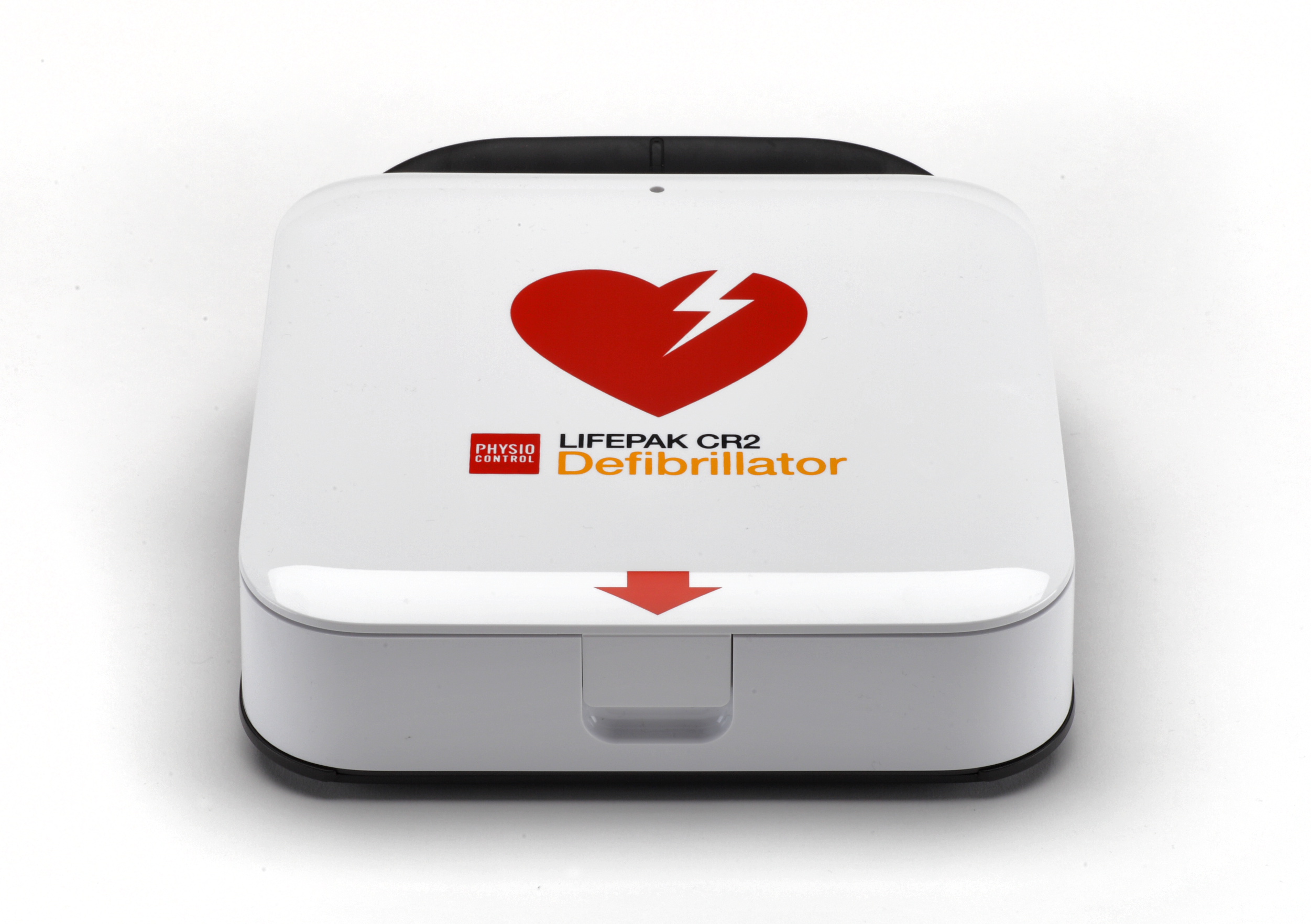
Pickering Safety is pleased to announce the expansion of our emergency response product offering as an authorized Stryker dealer.
For more than 30 years, Pickering Safety has supported first responders, fire departments, first aid providers, workplaces and organizations with dependable emergency medical and safety equipment. Our relationship with Stryker allows us to expand that support with some of the most recognized technology in emergency cardiac care and resuscitation.
Our growing Stryker portfolio includes the LIFEPAK CR2 AED, LIFEPAK 1000 Defibrillator, LIFEPAK 15 Monitor/Defibrillator, LUCAS 3 Chest Compression System, along with batteries, electrodes, accessories and replacement consumables.
Whether you are adding new equipment, replacing aging devices or developing a standardized cardiac response program, Pickering Safety can help you explore the equipment that fits your operational requirements.
LIFEPAK CR2 AED: Connected, Simple and Ready
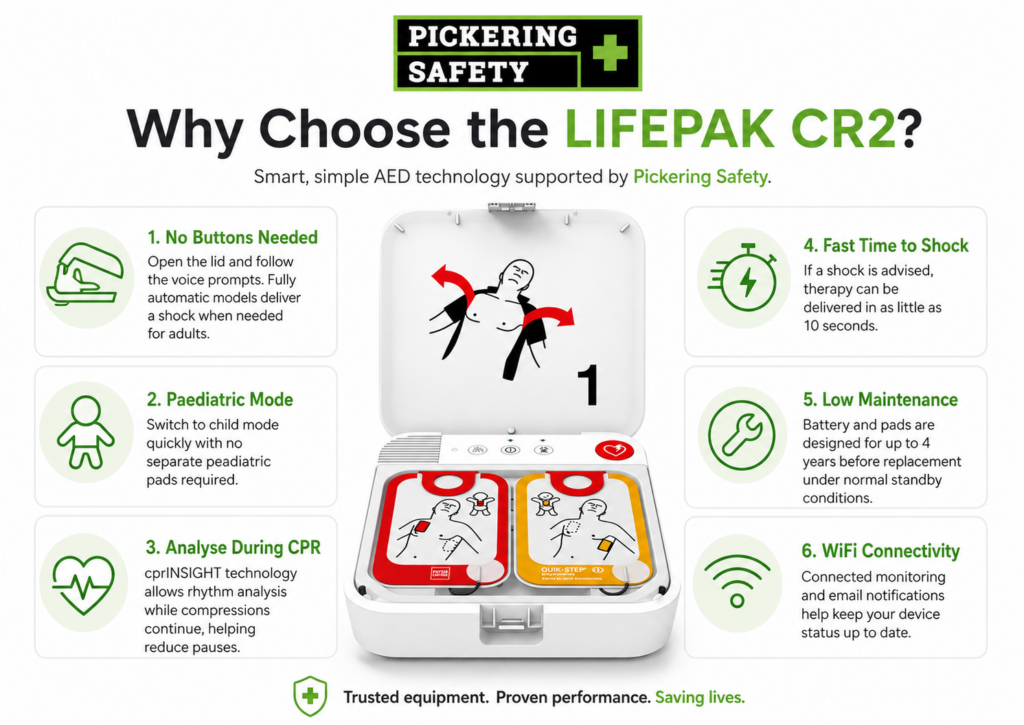
The LIFEPAK CR2 is designed to make responding to sudden cardiac arrest as straightforward as possible while incorporating advanced AED technology.
Simple graphics, audible instructions and automated features guide rescuers through the response. The CR2 also incorporates cprINSIGHT technology, which allows rhythm analysis during chest compressions, helping reduce unnecessary pauses in CPR.
Benefits of the LIFEPAK CR2
Simple operation
The CR2 is designed to help both trained and less-experienced responders quickly understand what to do during a cardiac emergency.
Adult and pediatric capability
Pediatric mode allows the device to be adapted for a child without requiring a separate set of pediatric electrodes.
Connected monitoring
Available connectivity features can help organizations monitor AED readiness and receive information about device status.
Continuity of care
The CR2 can transfer AED event information through Stryker’s connected systems, helping provide emergency responders with information about the cardiac arrest event.
For businesses, schools, industrial sites, recreation facilities and public-access locations, the CR2 provides a powerful combination of simplicity and connected AED management.
LIFEPAK 1000: Built for the First Responder Environment
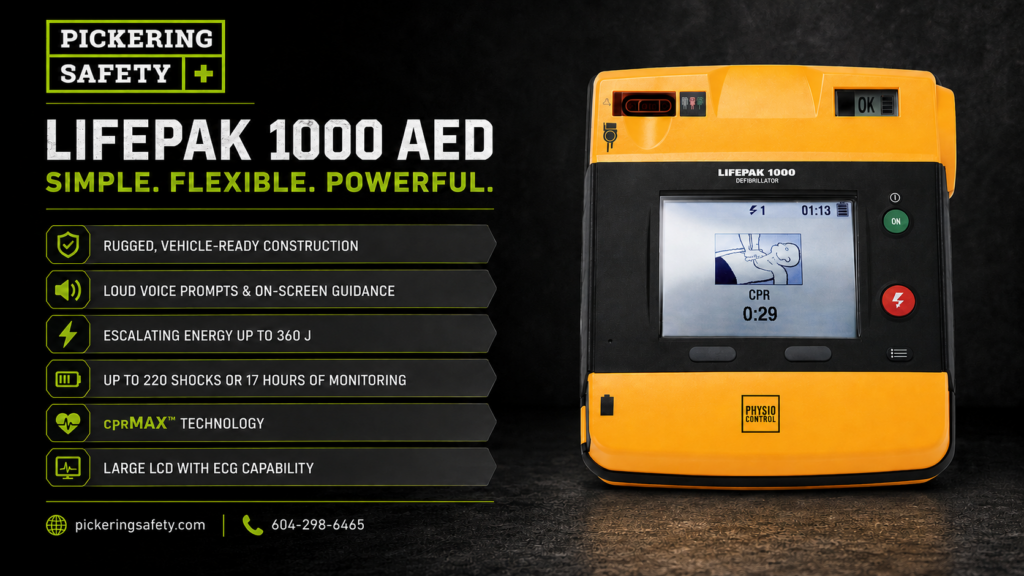
The LIFEPAK 1000 defibrillator bridges the gap between a traditional public-access AED and the requirements of professional responders.
It has been designed for demanding environments and incorporates rugged construction, a large display and advanced capabilities.
Benefits of the LIFEPAK 1000:
Rugged construction
The LIFEPAK 1000 is designed to withstand drops, vibration and demanding operating environments, making it well suited to mobile response applications.
Escalating energy up to 360 joules
The device can provide escalating biphasic energy up to 360 J.
Clear visual and audible guidance
Loud voice prompts and on-screen graphics provide responders with clear instructions during a resuscitation.
cprMAX technology
cprMAX technology is designed to help reduce interruptions in CPR by allowing responders to provide pre-shock CPR while the device charges.
Long battery capability
Stryker specifies battery capacity of up to 220 shocks or approximately 17 hours of monitoring, depending on use and operating conditions.
LIFEPAK 15: Advanced Monitoring for Professional Emergency Response
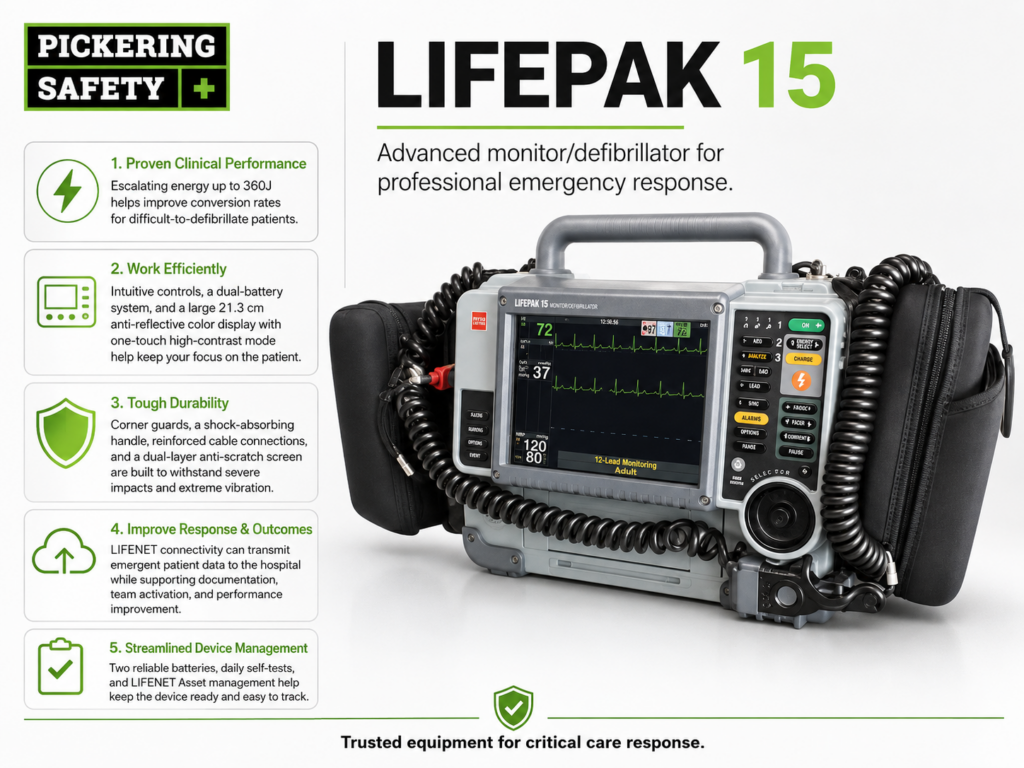
For advanced emergency care, the LIFEPAK 15 monitor/defibrillator combines monitoring, defibrillation and data capabilities in a rugged platform designed for professional responders.
Benefits of the LIFEPAK 15:
Escalating energy up to 360 joules
The LIFEPAK 15 provides escalating biphasic energy up to 360 J for difficult-to-defibrillate patients.
Advanced patient monitoring
The LIFEPAK 15 includes advanced ECG and monitoring capabilities, including 12-lead ECG functionality and ST-segment monitoring.
Large, highly visible display
Its 21.3 cm anti-reflective colour display includes a high-contrast mode to improve visibility in challenging environments.
Built for demanding operations
Corner guards, reinforced cable connections, a shock-absorbing handle and other durability features are designed for the realities of emergency response.
Connected patient information
Through the LIFENET System, compatible LIFEPAK 15 devices can transmit emergent patient information and support documentation, hospital notification and post-event review.
LUCAS 3 Chest Compression System: Consistent Mechanical CPR
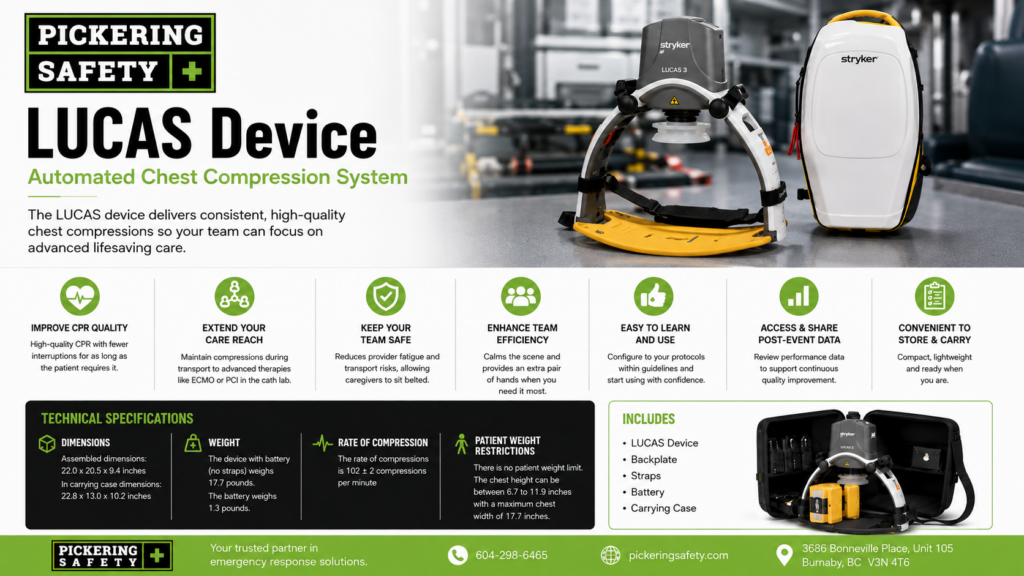
High-quality chest compressions are one of the most important elements of cardiac arrest resuscitation.
The LUCAS 3 Chest Compression System provides automated, guidelines-consistent chest compressions while allowing the resuscitation team to focus on other critical aspects of patient care.
Benefits of the LUCAS 3:
Consistent CPR
The system provides repeatable mechanical chest compressions while helping reduce variability caused by rescuer fatigue.
Supports CPR during transport
Mechanical compressions can continue during movement and transport, helping maintain CPR while the patient is being moved toward advanced treatment.
Supports responder safety
During transport, mechanical CPR can reduce the need for a provider to remain standing and performing manual compressions in a moving vehicle.
Improves team utilization
By handling chest compressions, LUCAS can free members of the resuscitation team to focus on airway management, vascular access, medications, rhythm management and treatment of reversible causes.
Post-event information
Compatible LUCAS 3 systems can connect with Stryker’s data platforms to support post-event reporting and quality-improvement review.
More Than the Device: Accessories and Ongoing Support
Emergency equipment is only useful when it is ready when you need it.
Pickering Safety can support customers with the associated products required to keep their emergency response equipment operational, including:
- AED electrodes and replacement pads
- Batteries
- Carrying cases
- Cables and accessories
- Replacement consumables
- AED cabinets and signage
- Equipment replacement planning
- AED program support
- Product sourcing and quotations
For organizations managing multiple AEDs or emergency-response devices, connected platforms such as Stryker’s LIFENET ecosystem can also assist with device readiness, notifications, data management and fleet oversight.
Why Work With Pickering Safety?
Buying emergency medical equipment is not simply about purchasing a device.
It is about choosing the right equipment for the environment, having access to the correct accessories and replacement consumables, and knowing where to turn when equipment needs to be replaced or expanded.
Pickering Safety combines access to Stryker emergency-care technology with the personal service of a Canadian emergency medical and safety supplier.
Whether you are responsible for one AED or an entire emergency-response equipment fleet, our team can help you evaluate your requirements and develop a solution appropriate for your organization.
Looking at New Emergency Response Equipment?
If your organization is considering a new AED, replacing existing defibrillators, expanding its cardiac response capabilities or looking at mechanical CPR technology, we would be pleased to help.
604-298-6465
customercare@pickeringsafety.com

Wildfires 2017
Wildfires During British Columbia Summers are Becoming More Common
This summer of 2017 is shaping up to be one of the most active wildfire seasons we’ve seen in years. Everyone is talking about the speed with which the fires emerged and the scale of damage that they are doing as over 200 wildfires rage across the province. In 2015, Pickering Safety published a blog post to raise awareness about fire safety and to highlight some products we carry that can help people do their part to prevent wildfires. This year, given the state of emergency we’re currently in, we’d like to focus solely on highlighting ways in which people can contribute to helping those who have lost their homes or who have otherwise been impacted.
Please Be Aware of Wildfires
Most of the active wildfires in the province were started by lightening storms, however, there are instances where cigarettes or neglected campfires have also contributed to, or started, a wildfire. Although fires started by humans via cigarettes, campfires, fireworks etc. can be contained, they eat up valuable resources that could be used to battle the much larger naturally occurring wildfires that are threatening peoples homes. During a state of emergency, every fire fighter’s time is highly valuable and shouldn’t be wasted putting out fires caused by avoidable, man-made situations. Campfires are strictly banned across the province right now and please be responsible with your cigarettes, fireworks or other potentially fire-causing instruments. Keep a fire extinguisher at your home and your office and perhaps a mask and some burn management first aid supplies on-hand in case of emergencies. Lastly, avoid highway routes that are near active wildfire zones. There have been quite a few road closures and evacuations throughout the summer across the province. If you have travel plans, keep yourself informed of areas you should avoid so as not to put unnecessary strain on the system.
Canadian Red Cross Fire Relief
The Canadian Red Cross is probably the largest and most active organization that’s helping those who have been impacted by the wildfires raging across the province. Their primary concern is helping those who have been evacuated find essentials like food, water and shelter. In their own words:
“Massive wildfires have triggered a province-wide state of emergency in British Columbia. Fast moving flames have forced thousands of people from their homes. Urgent support is needed for individuals and families evacuated from their communities.
The Canadian Red Cross is supporting the B.C. government in providing relief for those affected and a British Columbia Fires Appeal has been opened for Canadians who wish to help those in need.”
The Relief Effort Needs Time and Money
Safety should be everyone’s concern especially given the broad scope of this emergency. Anyone could be effected by a wildfire and it seems almost every summer a different group of people are massively impacted. The Canadian Red Cross Fire Relief has called for people to donate their time and money to helping their efforts. Volunteers can sign up on their website and monetary contributions can also be made online. There are further details on the specific initiatives your donations will help support also discussed on their website here.
WorkSafe BC cases are playing a crucial role in highlighting important issues that are caused by unsafe working conditions. Unsafe work practices and conditions can cause the workers to either be exposed directly to danger, or suffer from conditions that can lead to problems. In 2017, new WorkSafeBC issues have been arising that deserve attention because they are directly related to employee safety and may even influence new legislation in the future that employers should be aware of.
Mental Health and WorkSafeBC
In recent years WorkSafeBC has had to start paying attention to the many mental health cases that have emerged on job sites. The most notable case identified by WorkSafeBC is the suicide case of firefighter Ernie Dombrowski, as, according to WorkSafeBC, he suffered from workplace trauma and his family was awarded damages. Ernie’s case is a notable case that could lead to developments regarding the issue of mental health awareness, as there is a need to identify how work conditions can cause stress and mental issues specifically issues such as PTSD. The decision, according to Surrey Firefighters Association president Mike McNamara, will make it possible for other first responders to make claims related to mental health.
Holding Workers and Employers Accountable for Properly Wearing Safety Equipment
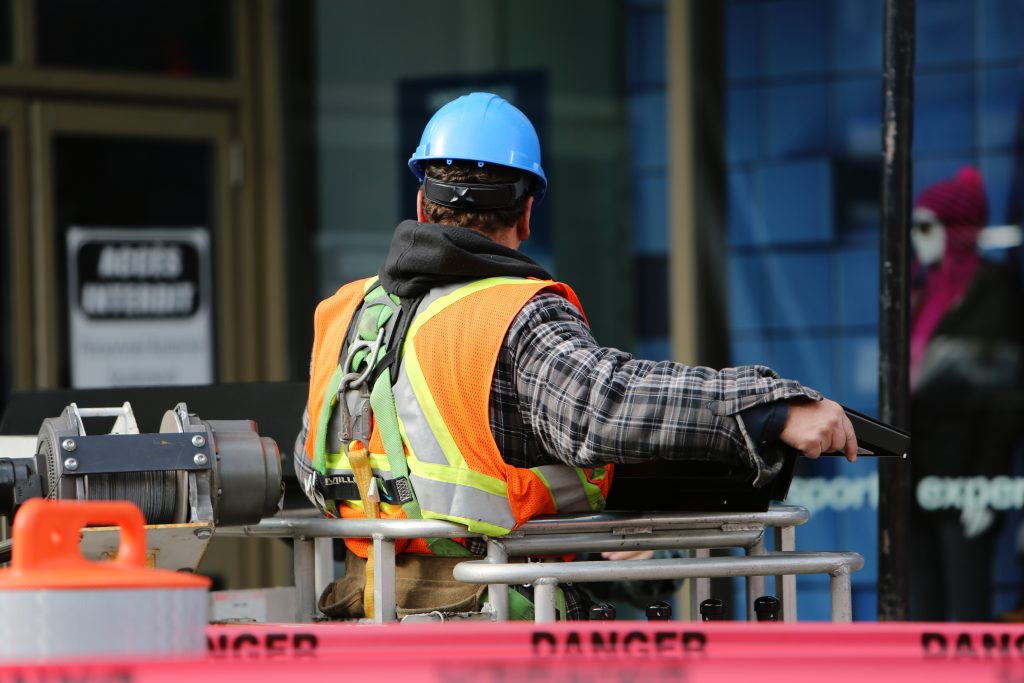
The second prominent case of WorkSafeBC highlights the issue of safety provision by employers, by providing research on how young workers in the industry generally do not wear safety equipment to prevent damage from loud noises, according to a member of WorkSafeBC, “Among construction workers age 21 or younger, 24 per cent reported not wearing hearing protection, as compared with 13 per cent of workers over age 50 and 11 per cent of workers in all other age groups. The data was collected in 2016 from more than 160,000 hearing tests — about 50,000 in construction — conducted by B.C. employers as part of hearing-loss prevention programs”. The case is important because it could increase the pressure on employers to not only provide hearing equipment but also encourage employers hold workers accountable for properly wearing the provided equipment on the job site.
Asbestos Testing and Pre-testing the Job Site
The third leading case, of WorkSafe BC is a case that could change the safety precautions in the construction industry. According to WorkSafe BC research, safety from Asbestos during construction is essential. The problem in construction industry in Canada is that while demolishing old houses there could be dangerous for workers, if the premises are not tested for asbestos safety beforehand. Asbestos can cause lung diseases and could even lead to the death of workers. Some of the materials or places containing asbestos could be:
- Vinyl tiles and linoleum sheet flooring;
- Roof felt and shingles;
- Loose, blown-in insulation, such as vermiculite;
- Stucco;
- Gypsum board filling compound, and patching and joint compound for walls and ceilings;
- Incandescent light fixture backing;
- Deck under sheeting.
(*List provided by WorkSafeBC)
The above cases could be influential in deciding the future of work place safety precautions and the measure employers would have to take to ensure employees’ mental and physical health safety.
Pickering Safety Can Help You Meet WorkSafeBC Requirements and Provide a Safe Working Environment for Your Employees
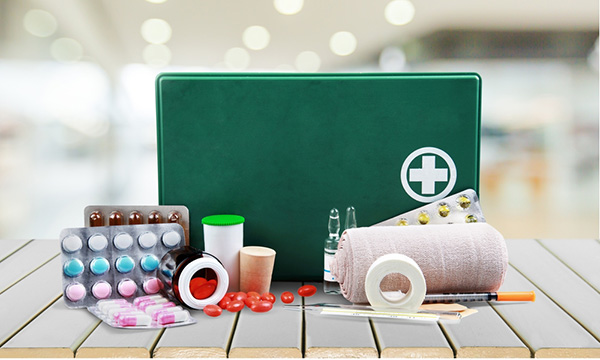
Accidents and injuries can occur anywhere – at home, at the workplace, while driving or while participating in sports events. They are not wished for but they do happen. Hence, it is essential to be prepared for such medical emergencies.
Keeping a first aid kit at home and in the office can help you respond effectively to common injuries and emergencies.
Here are the top ten reasons to keep a first aid kit at your home and office:
1. Treat Injuries Quickly:
First aid kits help you handle the medical emergencies as quickly as possible. In an emergency, a delay of just a single minute can cause irreconcilable damage. These kits offer basic and instant care for common medical injuries like injuries, burns, cuts etc.
2. Pickering Safety Can Build Kits Custom for Your Home or Workplace:
Pickering Safety first aid kits are customizable. If you work in a particular niche, we can build a first aid kit that contains suitable emergency equipment. We provide first aid kits to a wide array of businesses and professionals in the medical industry, police force and many businesses throughout the Lower Mainland.
3. Everything You Need in One Place:
A first aid kit contains all vital medical products in one easy location. So, in case of emergency, you do not have to waste valuable time assembling the appropriate medical items.
4. Less Risk of Complication:
A well-equipped first aid kit, in most cases, can prevent further complication with the injury or medical condition. Keeping a medical kit handy can be cost effective because it’s less likely a wound treated immediately with a first aid kit will require complex attention in the future.
5. Very Compact Package:
First aid kits contain all the essential medical contents in a very compact package. You can really take a first aid kit with you anywhere, whether you’re travelling or living/working in a small space. There’s really no excuse not to keep one on hand!
6. Keep Antibiotics Within Arms Reach:
In case of a cut, it’s imperative to use antibiotics as soon as possible to prevent infection. Pickering Safety First Aid Kits contain basic antibiotic ointments to be used in emergencies.
7. Stop Blood Loss Immediately:
Sometimes injuries are messy. Applying gauze and bandage immediately will stop the blood loss. It’s difficult to stop blood loss efficiently without the proper medical products on hand and prolonged blood loss can be quite dangerous.
8. Relieve the Pain of a Burn Instantly:
If a burn or scald occurs, first aid treatment should be applied to the affected area as quickly as possible. The goal is to relieve the pain and prevent further damage. Our Second Skin products make particularly useful additions to any first aid kit.
9. Prevent the Discomfort of Skin Irritation or Bug Bites:
Wounds and insect bites can be tremendously uncomfortable, if handled immediately and carefully with the appropriate first aid treatments, the irritation can heal faster and in a more effective way. This will prevent scarring!
10. Be a Helping Hand to a Child or Friend:
If nothing else convinces you – keep in mind that the people around you may not be as prepared as you are. Your first aid kit may come in handy if anyone around you experiences any of the injuries mentioned above. Kids and elderly people are most susceptible to injuries and accidents. First aid kits act as an indispensable medical item for all.