
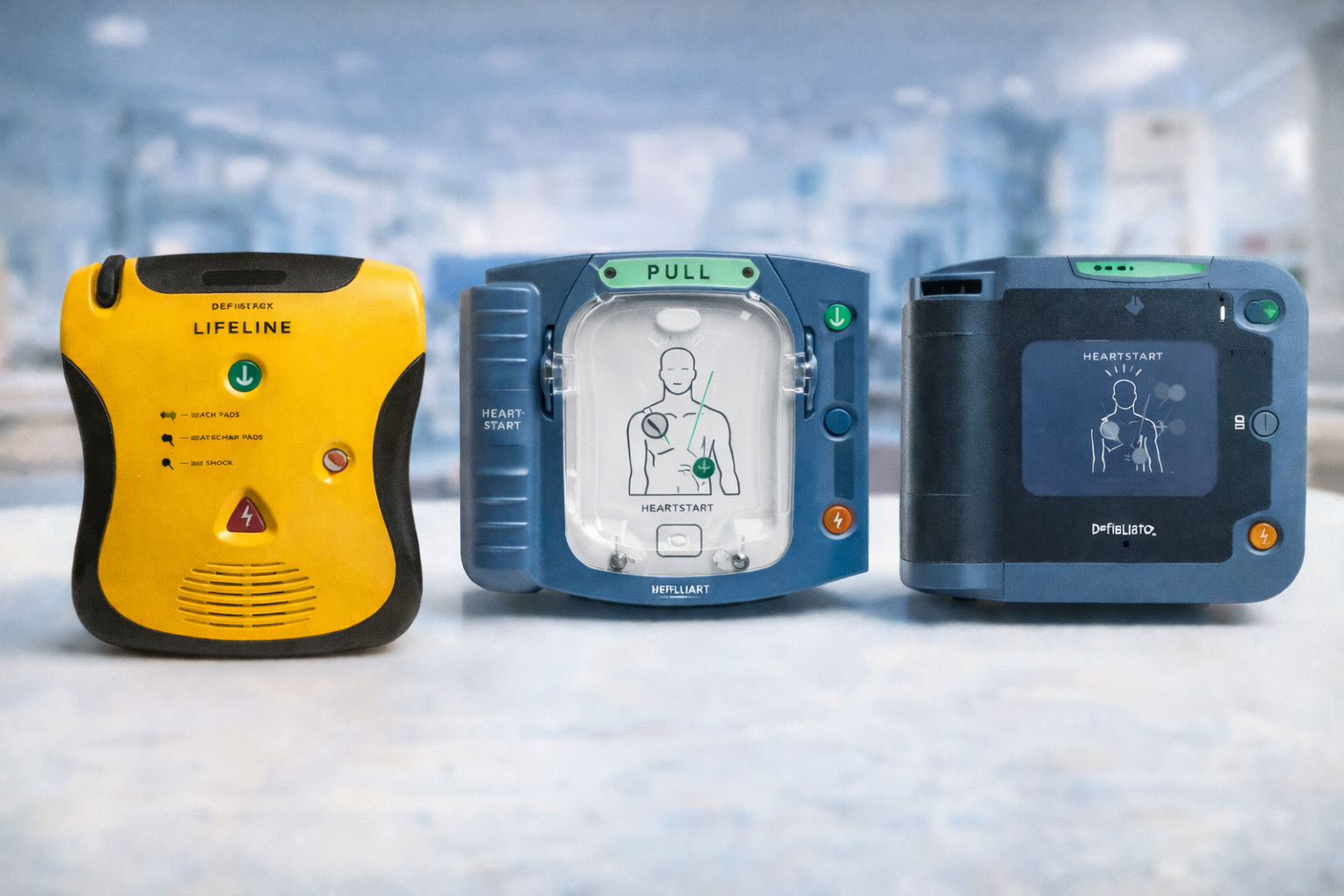
Defibtech Lifeline vs. Philips HeartStart HS1 vs. Philips HeartStart FRx: Which AED Makes the Most Sense in 2026?
The newest 2025 American Heart Association (AHA) CPR & ECC Guidelines keep reinforcing the same operational truth: outcomes tell the story of speed + simplicity. Your AED program should be built so a bystander can act quickly, correctly, and with as little hesitation as possible.
If you’re choosing between three of the most common “public access” AEDs, this comparison is for you:
Below is a spec-based comparison, followed by what product reviews repeatedly praise (and nitpick) about each.
Quick take
- Pick the Philips HS1 (OnSite) if your priority is the most guided, confidence-building user experience for lay responders in cleaner indoor environments.
- Pick the Philips FRx if you want the most “ready for rough conditions” Philips option: water-jet + dust protection and a streamlined pediatric approach via the Infant/Child Key.
- Pick the Defibtech Lifeline if you want a durable, straightforward two-button AED with strong readiness features and long standby battery options (depending on battery pack).
Side-by-side comparison (the specs that matter during a real rescue)
| Feature | Defibtech Lifeline (DDU-100) | Philips HeartStart HS1 (OnSite) | Philips HeartStart FRx |
|---|---|---|---|
| Intended user | Lay responders; simple prompts | Lay responders; “coach-like” adaptive prompts | Lay responders / trained responders; icon + voice guidance |
| Adult energy | 150 J nominal | 150 J nominal | 150 J nominal |
| Pediatric approach | Separate child/infant pads (50 J nominal) | Optional Infant/Child SMART Pads cartridge | Infant/Child Key (same SMART Pads II) |
| Water/dust protection | IP54 (dust protected, splash proof) | IP2X + protected against water drops | IPX5 + IP5X (water-jet proof + dust protected) |
| Weight (approx.) | 4.2–4.4 lb (1.9–2.0 kg) | 3.3 lb (1.5 kg) | ~1.5 kg (varies by config) |
| Charge time / “speed” notes | ≤ 4 seconds from “shock advised” | “Quick Shock” typically ~8 seconds after CPR pause | “Quick Shock” typically ~8 seconds after CPR pause |
| CPR help | Metronome + voice prompts | Voice prompts + optional CPR coaching | Voice prompts + metronome + CPR coaching |
| Self-tests | Daily/weekly/monthly/quarterly + pad presence test | Daily/weekly/monthly + pad integrity/gel moisture check | Daily/weekly/monthly + pad readiness checks |
| Battery standby (typical) | 5–7 years (battery pack dependent) | 4 years typical | 4 years typical |
Real-world decision points (how most teams choose)
1) Where will this AED live: office hallway or job site?
This single factor eliminates a lot of indecision.
- HS1 (OnSite) is ideal for cleaner indoor settings. It’s protected against solid objects (IP2X) and water drops, but it’s not built for heavy weather, spray, or dust exposure.
- Lifeline is a strong middle ground with IP54 (dust protected, splash proof).
- FRx is the most rugged of the three here, with IPX5 water-jet proof + IP5X dust protection, plus a design positioned for demanding environments.
If your AED could be used outdoors, near washdown areas, loading bays, marine/athletics environments, or industrial spaces, FRx usually wins the environment test.
2) Pediatric readiness: “one system” vs. “separate child pads”
This is one of the biggest program-risk issues: the pediatric accessory isn’t there when you need it.
- FRx: insert the Infant/Child Key and the AED adjusts instructions and energy, using the same SMART Pads II.
- HS1: uses a separate Infant/Child SMART Pads cartridge (often cited in reviews as an add-on you must plan for).
- Lifeline: requires child/infant pads for pediatric energy (50 J nominal).
If you want the lowest “oops, we’re missing the pediatric pads” risk, FRx’s key-based approach is hard to beat.
3) Maintenance reality: the AED you can keep ready is the best AED
All three do self-tests. The program usually fails elsewhere: expired pads, dead batteries, or a readiness indicator no one checks.
- Lifeline stands out if your sites are distributed or maintenance is inconsistent, because it offers 5–7 year standby life depending on the battery pack.
- HS1 and FRx are typically 4-year standby AEDs (common, solid, predictable).
What reviews consistently say (themes that show up repeatedly)
Defibtech Lifeline: what reviewers like
Common praise shows up around:
- Simple, unintimidating operation (often described as easy for non-medical responders)
- Durability (IP54 is a recurring point) and “straightforward” rescue flow
- Battery flexibility for long standby readiness
Common caveats:
- It’s heavier than the HS1
- Pediatric readiness depends on keeping child pads in-date and in the cabinet
Philips HeartStart HS1 (OnSite): what reviewers like
Reviewers frequently highlight:
- A very guided, confidence-building prompt system, with adaptive pacing that “waits” for the rescuer
- Lightweight and easy to mount, carry, and deploy in offices/community settings
Common caveats:
- It’s not the rugged choice compared with IP54/IP55-style devices (its sealing spec is much lower)
- Pediatric use typically requires buying and managing the separate Infant/Child pads cartridge
Philips HeartStart FRx: what reviewers like
The recurring positives:
- Ruggedness for real-world conditions (water-jet and dust protection are a big reason people choose it)
- Clear voice prompts + icons + CPR coaching that work well for mixed-experience teams
- The Infant/Child Key is regularly called out as a practical pediatric solution
Common caveats:
- Often perceived as the more “premium” pick, so some reviews frame it as a higher-cost choice depending on accessories and program setup
So… which one should you buy?
Choose Philips HeartStart HS1 (OnSite) if:
- Your AED will live mostly indoors (office, retail, community spaces)
- You want the most step-by-step coaching for lay responders
- You value lightweight + easy deployment
Choose Philips FRx if:
- Your AED may face weather, dust, splash, or rough handling
- You want the strongest environmental protection of the three
- Pediatric readiness matters and you prefer the Infant/Child Key approach
Choose Defibtech Lifeline (DDU-100) if:
- You want a durable, simple AED with IP54
- You care about long standby battery options for lower-touch maintenance
- You like the “two-button, straightforward” user experience
Quick take
- Choose Philips HeartStart HS1 if your priority is ultra-simple operation for untrained responders and a “guided, hand-holding” experience.
- Choose Defibtech Lifeline if your priority is durability (dust/splash resistance), a very straightforward interface, and strong long-term readiness features.
Side-by-side comparison (specs that matter at 9:42 a.m. on a chaotic Tuesday)
| Feature | Philips HeartStart HS1 (OnSite) | Defibtech Lifeline (DDU-100) |
|---|---|---|
| Intended user | Lay responder / minimal training | Lay responder / minimal training |
| Adult energy | 150 J nominal | 150 J nominal |
| Pediatric capability | With Infant/Child SMART Pads cartridge (lower energy) | With child/infant pads (50 J nominal) |
| Weight | ~1.5 kg (3.3 lb) with battery/pads | ~1.9–2.0 kg (4.2–4.4 lb) depending on battery |
| Water/dust protection | IP2X / drip-proof IPX1 | IP54 dust protected / splash proof (battery installed) |
| CPR help | Voice prompts + optional CPR coaching | Voice prompts + CPR metronome |
| Time-to-shock style details | “Quick Shock” capability; typical shock after CPR interval in ~8 seconds | Charge time listed as 4 seconds or less (from “shock advised”) |
| Readiness checks | Automated self-tests + pads integrity (gel moisture) checks | Automated self-tests; pads preconnected tested daily |
| Event data | IR (IrDA) transfer; stores ECG + event data | Event data downloadable; optional removable data card |
| Battery (typical standby) | ~4 years typical | 5–7 years depending on battery pack |
| Warranty (commonly listed) | HS1/FRx shipped after Dec 1, 2011: 8 years | 8 years (Defibtech limited warranty doc) |
Real-world decision points (what actually changes the “right” choice)
1) Environment: office hallway vs. job site vs. pool deck
If your AED will live in a clean, climate-controlled space, both are solid.
But if it’s going anywhere near dust, rain, splash, marine air, outdoor athletics, loading bays, or industrial sites, the Lifeline’s IP54 rating is a meaningful advantage over the HS1’s drip-proof IPX1 style protection.
Translation: Lifeline tends to be the safer bet for harsher conditions.
2) “Make it impossible to mess up” simplicity
The HeartStart HS1 is built around guided steps and a very “talk-you-through-it” experience. Philips positions it as step-by-step guidance from pad placement through CPR.
The Defibtech Lifeline is also simple, but with a more “direct” feel: strong voice prompts, a CPR metronome, and a rugged, straightforward design.
If your AED will be used by the general public (lobby, community center, small business) and you want maximum coaching, the HS1 tends to win on feel.
3) Readiness and maintenance: the boring part that saves you
AED programs fail in predictable ways: expired pads, dead batteries, and “we assumed it was fine.”
Both units have self-tests. Philips highlights automated tests plus pads integrity/gel moisture checks.
Defibtech’s spec sheet highlights scheduled self-tests and that preconnected pads are tested daily.
What’s more important than brand: pick the AED you can realistically keep compliant (scheduled checks, documented inspections, and a vendor who helps you stay on top of consumables).
What reviews consistently say (patterns from multiple reviewers)
Philips HeartStart HS1: what people like
Across reviews, the praise usually clusters around:
- Confidence-building prompts and guidance (good for low-training environments)
- Light weight and compact footprint
- A “ready-to-go” feel with clear status indicators and simple setup
Common review caveats:
- It’s less rugged than models aimed at industrial/outdoor use (its sealing/drip-proof ratings reflect that).
- Pediatric use may require additional accessories (and in some markets, those can have purchasing restrictions).
Defibtech Lifeline: what people like
Reviewers frequently highlight:
- Durability and job-site friendliness (IP54 is a recurring selling point)
- Simple, uncluttered interface with strong voice prompts and CPR metronome
- Practical program features like downloadable event documentation and optional removable storage
Common review caveats:
- It’s a bit heavier/larger than the HS1.
- Like any AED, total cost of ownership depends on your battery choice and consumables plan (pads/battery replacement cycles).
A 2026 buyer’s note: don’t ignore safety notices
This isn’t about fear, it’s about program maturity.
Philips has issued safety communications on certain HS1 pads cartridges in the past (example: a notice describing a potential gel issue for specific SMART Pads cartridges).
And the FDA recall database shows a past Class 2 recall record for certain Philips HeartStart HS1 models (status shown as terminated, with the page updated in January 2026).
Bottom line: whichever brand you choose, make “recall/safety notice checks” part of your routine maintenance process.
Which AED should you buy?
Pick Philips HeartStart HS1 (OnSite) if you want:
- Maximum step-by-step coaching for untrained users
- A lighter unit for wall cabinets, offices, and public spaces
- A highly guided user experience that reduces hesitation
Pick Defibtech Lifeline (DDU-100) if you want:
- Better dust/splash resistance for tougher environments (IP54)
- Straightforward prompts + CPR metronome, minimal fuss
- Battery options that support longer standby life depending on configuration
The smartest move (regardless of model)
The AHA guidelines can talk about systems of care all day, but your real win is simpler:
- Put the AED where it can be reached fast.
- Train just enough people to eliminate “freezing.”
- Set a maintenance cadence (pads, batteries, readiness indicator checks, documentation).
- Keep up with safety notices.
Do that, and either of these AEDs can be the right one.
If you want, tell me where the AED will be installed (office, warehouse, construction site, school, gym, outdoors, near water), and I’ll recommend the better fit plus a simple maintenance checklist you can copy into your safety binder.
The latest 2025 American Heart Association (AHA) CPR & ECC Guidelines keep pushing the same practical reality: early CPR + early defibrillation saves lives, and systems should be built so a bystander can act fast.
So if you’re buying (or upgrading) an AED program this year, the question isn’t “Are AEDs worth it?” It’s: Which unit will your team actually use correctly, under stress, with the least friction?
Two of the most common choices are the Philips HeartStart HS1 (OnSite) and the Defibtech Lifeline (DDU-100 series). Here’s a clear, real-world comparison, including what reviews consistently praise (and nitpick) about each.