
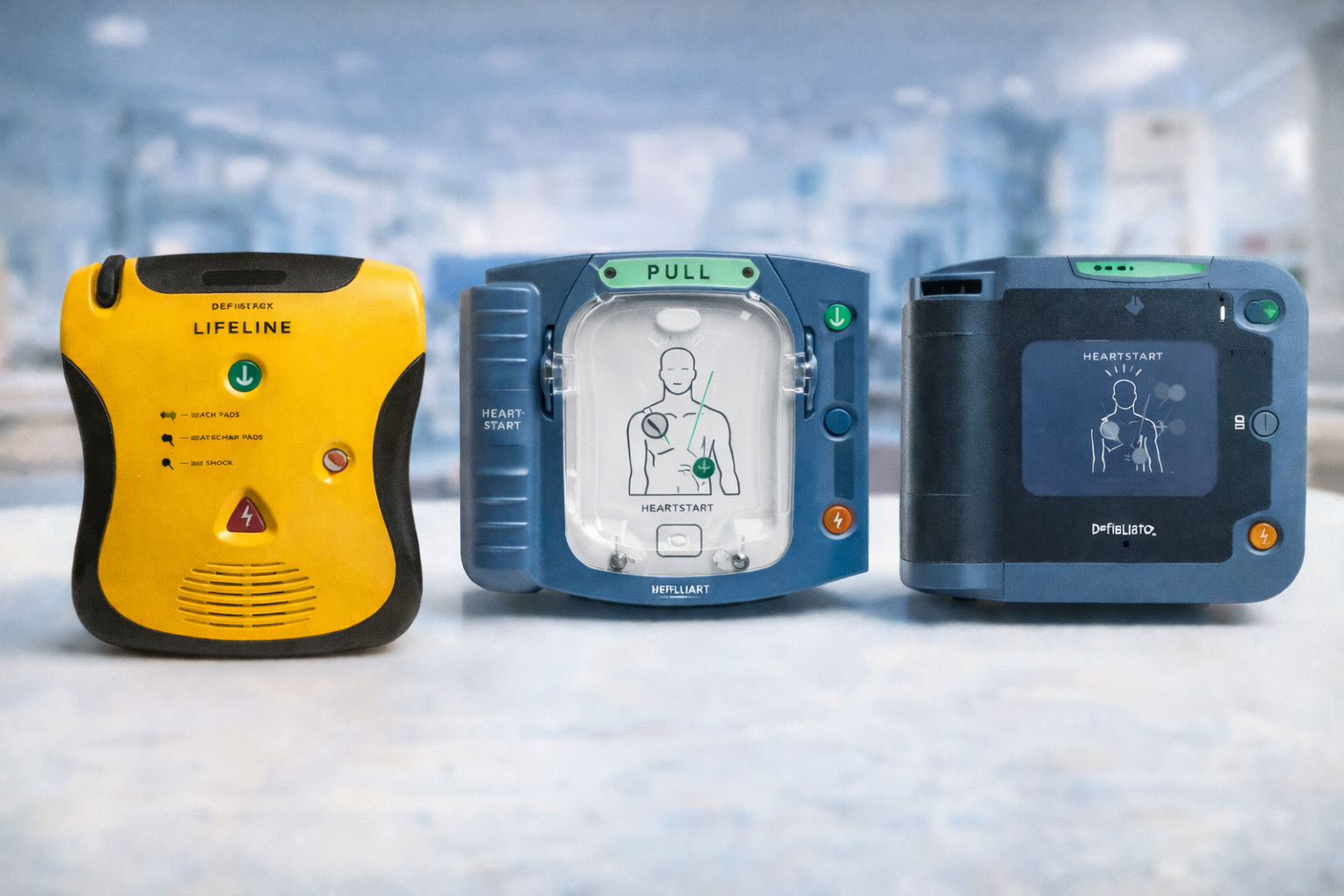
Defibtech Lifeline vs. Philips HeartStart HS1 vs. Philips HeartStart FRx: Which AED Makes the Most Sense in 2026?
The newest 2025 American Heart Association (AHA) CPR & ECC Guidelines keep reinforcing the same operational truth: outcomes tell the story of speed + simplicity. Your AED program should be built so a bystander can act quickly, correctly, and with as little hesitation as possible.
If you’re choosing between three of the most common “public access” AEDs, this comparison is for you:
Below is a spec-based comparison, followed by what product reviews repeatedly praise (and nitpick) about each.
Quick take
- Pick the Philips HS1 (OnSite) if your priority is the most guided, confidence-building user experience for lay responders in cleaner indoor environments.
- Pick the Philips FRx if you want the most “ready for rough conditions” Philips option: water-jet + dust protection and a streamlined pediatric approach via the Infant/Child Key.
- Pick the Defibtech Lifeline if you want a durable, straightforward two-button AED with strong readiness features and long standby battery options (depending on battery pack).
Side-by-side comparison (the specs that matter during a real rescue)
| Feature | Defibtech Lifeline (DDU-100) | Philips HeartStart HS1 (OnSite) | Philips HeartStart FRx |
|---|---|---|---|
| Intended user | Lay responders; simple prompts | Lay responders; “coach-like” adaptive prompts | Lay responders / trained responders; icon + voice guidance |
| Adult energy | 150 J nominal | 150 J nominal | 150 J nominal |
| Pediatric approach | Separate child/infant pads (50 J nominal) | Optional Infant/Child SMART Pads cartridge | Infant/Child Key (same SMART Pads II) |
| Water/dust protection | IP54 (dust protected, splash proof) | IP2X + protected against water drops | IPX5 + IP5X (water-jet proof + dust protected) |
| Weight (approx.) | 4.2–4.4 lb (1.9–2.0 kg) | 3.3 lb (1.5 kg) | ~1.5 kg (varies by config) |
| Charge time / “speed” notes | ≤ 4 seconds from “shock advised” | “Quick Shock” typically ~8 seconds after CPR pause | “Quick Shock” typically ~8 seconds after CPR pause |
| CPR help | Metronome + voice prompts | Voice prompts + optional CPR coaching | Voice prompts + metronome + CPR coaching |
| Self-tests | Daily/weekly/monthly/quarterly + pad presence test | Daily/weekly/monthly + pad integrity/gel moisture check | Daily/weekly/monthly + pad readiness checks |
| Battery standby (typical) | 5–7 years (battery pack dependent) | 4 years typical | 4 years typical |
Real-world decision points (how most teams choose)
1) Where will this AED live: office hallway or job site?
This single factor eliminates a lot of indecision.
- HS1 (OnSite) is ideal for cleaner indoor settings. It’s protected against solid objects (IP2X) and water drops, but it’s not built for heavy weather, spray, or dust exposure.
- Lifeline is a strong middle ground with IP54 (dust protected, splash proof).
- FRx is the most rugged of the three here, with IPX5 water-jet proof + IP5X dust protection, plus a design positioned for demanding environments.
If your AED could be used outdoors, near washdown areas, loading bays, marine/athletics environments, or industrial spaces, FRx usually wins the environment test.
2) Pediatric readiness: “one system” vs. “separate child pads”
This is one of the biggest program-risk issues: the pediatric accessory isn’t there when you need it.
- FRx: insert the Infant/Child Key and the AED adjusts instructions and energy, using the same SMART Pads II.
- HS1: uses a separate Infant/Child SMART Pads cartridge (often cited in reviews as an add-on you must plan for).
- Lifeline: requires child/infant pads for pediatric energy (50 J nominal).
If you want the lowest “oops, we’re missing the pediatric pads” risk, FRx’s key-based approach is hard to beat.
3) Maintenance reality: the AED you can keep ready is the best AED
All three do self-tests. The program usually fails elsewhere: expired pads, dead batteries, or a readiness indicator no one checks.
- Lifeline stands out if your sites are distributed or maintenance is inconsistent, because it offers 5–7 year standby life depending on the battery pack.
- HS1 and FRx are typically 4-year standby AEDs (common, solid, predictable).
What reviews consistently say (themes that show up repeatedly)
Defibtech Lifeline: what reviewers like
Common praise shows up around:
- Simple, unintimidating operation (often described as easy for non-medical responders)
- Durability (IP54 is a recurring point) and “straightforward” rescue flow
- Battery flexibility for long standby readiness
Common caveats:
- It’s heavier than the HS1
- Pediatric readiness depends on keeping child pads in-date and in the cabinet
Philips HeartStart HS1 (OnSite): what reviewers like
Reviewers frequently highlight:
- A very guided, confidence-building prompt system, with adaptive pacing that “waits” for the rescuer
- Lightweight and easy to mount, carry, and deploy in offices/community settings
Common caveats:
- It’s not the rugged choice compared with IP54/IP55-style devices (its sealing spec is much lower)
- Pediatric use typically requires buying and managing the separate Infant/Child pads cartridge
Philips HeartStart FRx: what reviewers like
The recurring positives:
- Ruggedness for real-world conditions (water-jet and dust protection are a big reason people choose it)
- Clear voice prompts + icons + CPR coaching that work well for mixed-experience teams
- The Infant/Child Key is regularly called out as a practical pediatric solution
Common caveats:
- Often perceived as the more “premium” pick, so some reviews frame it as a higher-cost choice depending on accessories and program setup
So… which one should you buy?
Choose Philips HeartStart HS1 (OnSite) if:
- Your AED will live mostly indoors (office, retail, community spaces)
- You want the most step-by-step coaching for lay responders
- You value lightweight + easy deployment
Choose Philips FRx if:
- Your AED may face weather, dust, splash, or rough handling
- You want the strongest environmental protection of the three
- Pediatric readiness matters and you prefer the Infant/Child Key approach
Choose Defibtech Lifeline (DDU-100) if:
- You want a durable, simple AED with IP54
- You care about long standby battery options for lower-touch maintenance
- You like the “two-button, straightforward” user experience